Hey everyone, I hope my last story gave you a taste of what I want to share from now on. I love the feeling of being able to tell your story to someone (in this case, Medium) without expecting anything in return, just finding peace of mind in the flow. But now, let’s begin.
From Idea to Product
This is one of the hardest steps that a startup founder will take at the beginning of their journey: creating a Minimum Viable Product (MVP), or as we can describe it, a scrappy version of your product or service. Our biggest challenge was, where do we start? How do we launch a service business that involves a large team of doctors and healthcare professionals to make the service work?
Just a little bit of context before I start the story…
I don’t know if you remember, but three years ago, we were in the midst of one of the biggest health pandemics imaginable. We experienced the impact of COVID-19 literally everywhere in the world. And, after all, we managed to survive.
However, I need to tell you that this pandemic was beneficial in some ways, especially for our idea. Because of the lockdown, nobody could leave their houses, and as a result, people needed to rely more and more on digital health technologies. As time went on, Brazil’s government started to create new policies and laws to regulate this kind of service. Before COVID-19, we did not have a solid legal framework for telehealth solutions.
Maybe, just maybe, our startup wouldn’t have existed if these changes hadn’t occurred.
So, what was our first step? We wanted to create a fully technological health startup, but we weren’t developers. We needed to start somehow, to begin caring for people. But what would be our business model? To whom were we going to sell? After a lot of discussions, we decided the best way was to start by testing our idea within companies, or as we call it in the startup language, B2B (business-to-business).
And why did we choose this model?
We believed that reaching exponential growth by selling to enterprises would be “cheaper” than starting with consumers. In the vast world of B2C (business-to-consumer), we would compete with all the biggest incumbents and have to spend a huge amount of money on advertisement and marketing campaigns — a little game of attention. I know things are different now, but that was our initial thought.
Selling to companies only required (at first, and I repeat, at first) a person who could follow a commercial outbound process. This is the ROI game that we tried to play.
The First MVP

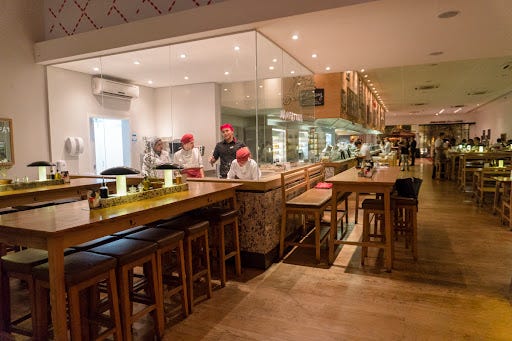
We want to create a digital healthcare service where anyone can easily contact their healthcare team at any time. But how do we take the first step in making this a reality? We realized we needed to start by caring for someone, anyone, to see how it would work in practice. But the big questions were: who would be our first patient, and more importantly, how would we effectively provide this care through a digital platform?
I remember discussing an article that highlighted some crucial advice for beginner founders: “you need to go talk to someone” and “go outside your houses.” This advice resonated with us, and we decided to literally hit the streets and talk to people. Luckily, Olívio had a friend who owned a “casa de massas” (pasta house) nearby. We stopped by and talked to the owner to get his feedback on our idea.
To our surprise, we secured our first trial; we would “take care” of his team for a while to test if our concept would work, at no cost to him.
We had our first client, so what was the next step?
To start, Olivio reached out to one of his physician friends to help with our MVP. We agreed to pay him a small fee to conduct medical consultations with the employees of the restaurant. He agreed, understanding that these would be simple talks to help us understand the product’s feasibility.
Next, we faced the challenge of determining our technology. What would be our “backend” and “frontend”? Surprisingly, we decided to use WhatsApp. Thanks to Mark, this simple app, which everyone in Brazil is familiar with, was the easiest path to follow. It eliminated technological barriers and was intuitive for everyone.
On our first day at the restaurant, we arrived in the morning to meet the team and start our “onboarding.” We explained the project, and although the team was curious about where it would lead, they agreed to follow our strategies.
Our MVP involved providing medical consultations via video calls using WhatsApp. We set up a place in the restaurant where team members could sit and meet with the doctor. We focused on the lighting, the duration of the consultations, what the doctor would say, and gathered feedback after each appointment — everything was meticulously planned.
We ran this experiment for two straight months, but then we hit a significant problem. The COVID-19 lock down started in São Paulo, forcing everyone to stay home. We could no longer engage with the restaurant employees, and unfortunately, the restaurant eventually had to close its doors.
Although we had to stop due to the lockdown, those two months were invaluable. We learned a great deal about the practical aspects of our service and the real impact it could have on people’s lives. We got to know their stories, their problems, their families, and everything related to them. The feedback we received was overwhelmingly positive; having someone looking out for them, even if just to talk, was significantly beneficial. They felt they could rely on us when experiencing health issues.
This was our first big insight: we needed to understand each person, every client, to provide personalized healthcare.
Here’s a practical example:
During our time there, we encountered a significant case: a team member had been experiencing weight loss and coughing up blood. We advised him to visit a UBS (Basic Health Unit) for tests, and it turned out he had HIV. He began treatment for this disease because of our intervention.
This experience laid the foundation for our next steps, even in the face of unexpected challenges.
Just for the record, our initial name was “Organização de Atendimento Responsável” or “O AR,” which translates to “the air” in English. I know, not very exciting. But later i will tell the story about the name “Ana Health”
An App?
After this initial phase, we wondered, “Why not build our own app? Everyone is building an app; it shouldn’t be that hard.” However, as I mentioned before, we weren’t technical people. So our first step was connecting with the University of São Paulo. We reached out to a junior enterprise (a non-profit company run by university students, but they charged big for projects).
After a month of discussions and creating numerous PowerPoint presentations about the functionalities we envisioned, we realized that creating this app without a technical co-founder was very challenging. The idea seemed impractical, and we risked spending a lot of money on something we weren’t sure would work.
We began studying other models that didn’t require extensive technical expertise and found some interesting studies from China about “micro apps.”
Micro Apps
Micro apps are lightweight applications that run within a larger platform, such as messaging apps like WeChat. They are designed to be fast, easy to use, and require minimal installation, making them accessible to a broad audience. These apps offer specific functionalities and can be integrated seamlessly into users’ daily routines without the need for a standalone app. By leveraging an existing platform, micro apps reduce the barriers to entry and can quickly scale to meet user needs.
This approach seemed perfect for us. We could leverage a platform that people were already familiar with, eliminating the need for extensive technological development on our part. This way, we could focus on what we did best: providing personalized healthcare.
And them, we headed back to our very first idea. The good and old WhatsApp.
The Final Product
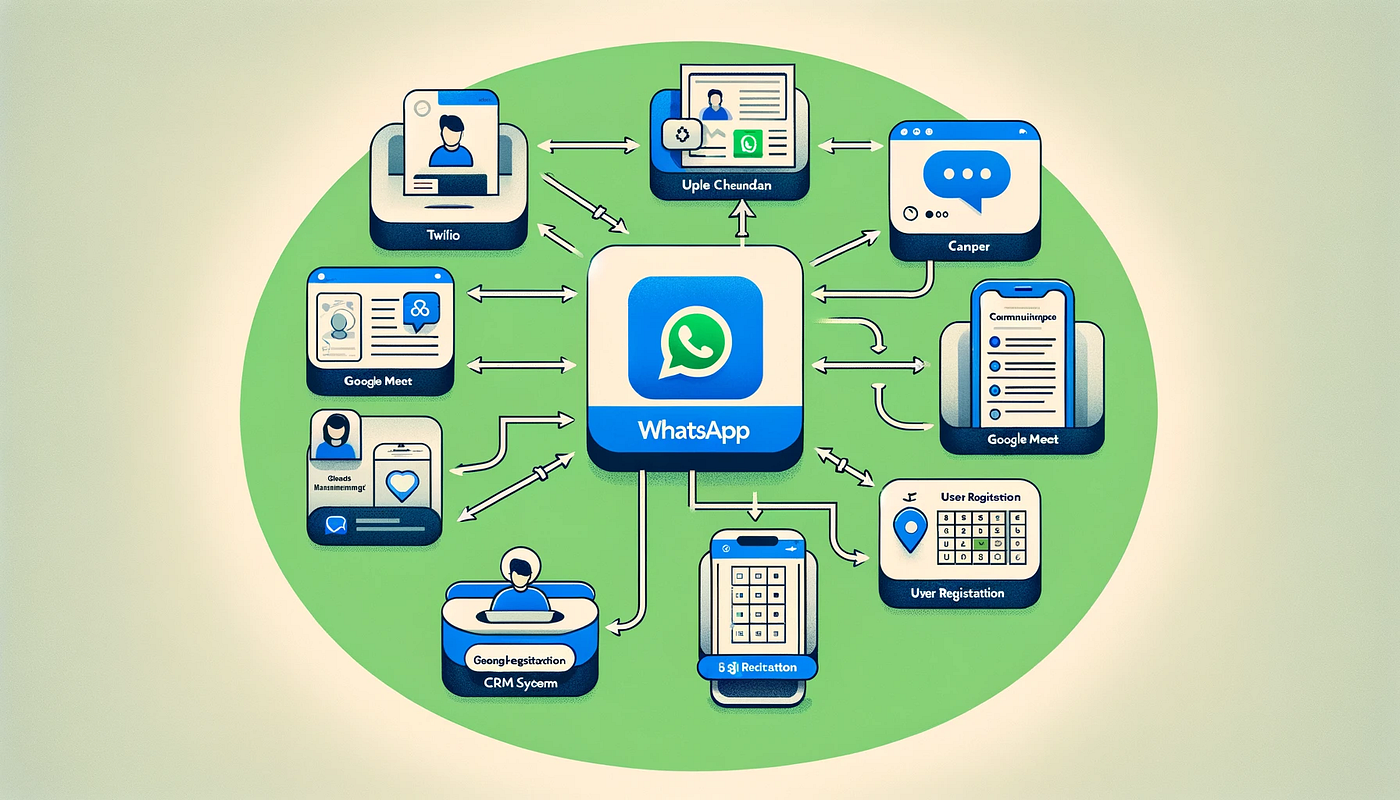
After our initial trials and research, we finally developed our final product. We found a company called Twilio, which provides cloud communications solutions such as SMS, voice, and messaging services. We decided to integrate Twilio with WhatsApp to connect all our associates. This way, all communications would be directed to a single platform where our healthcare professionals could manage them efficiently.
For video calls, we chose to use Google Meet. We created unique links for each consultation, which we sent to our clients, enabling seamless video communication. This solved the challenge of remote consultations in a user-friendly manner.
Next, we faced the problem of scheduling appointments. We came up with a simple solution: using Calendly. This allowed us to generate links easily and let users schedule their appointments at convenient times. They could also specify the type of consultation they needed, making the process straightforward and flexible.
We had to consider our CRM (Customer Relationship Management) system. We needed to track where each client was in their care process, manage their medical records, and handle their billing information. To address this, we created a comprehensive information framework that became the backbone of our product. The choosen platform was pipedrive, a cheap and easy to use.
And finaly, To streamline the user registration process, we hosted a front-end interface on the Twilio platform. This interface was responsible for collecting user information, such as CPF numbers and phone numbers. Once users filled out the registration form, their information was immediately linked to our CRM API.
This seamless integration ensured that every new registration was automatically recorded in our CRM system, enabling us to instantly integrate new users into the platform and provide them with access to our healthcare services.
Our final product thus consisted of:
- Twilio Integration: For managing all communications through WhatsApp.
- Google Meet: For conducting video consultations with unique, secure links.
- Calendly: For easy scheduling of appointments and managing consultation types.
- CRM System (Pipedrive): For tracking client progress, managing medical records, and handling billing.
- User Registration Interface: For collecting user information (such as CPF and phone numbers) and integrating it into the CRM system.
By integrating these tools, we built a robust, user-friendly digital healthcare platform that allowed us to provide personalized and efficient care to our clients.
Conclusion
This journey has been long but playful, offering a delightful experience in taking ideas from mere concepts and applying them in the real world. There’s a lot to learn from simple actions. We must always focus on things that are not immediately scalable to pave the way to our most value insights.
In the next story, I’ll share the journey of selling your product to someone — a tale of hearing “no” literally a thousand times.
And Thanks a LOT again guys, i have received very nice feedback from my friends and that is the key fuel to continuing on writing. Feel free to give feedback on the comment section, it would be really nice to hear from you. Love u all!